From Activation to Causality
Discovery of Causal Visual Representations in the Human Brain
* Equal contribution
 2
2

Overview. Identifying which brain regions represent a visual concept in the human brain is a central challenge in neuroscience. Strong activation alone does not establish that a region represents the concept itself, as responses may instead be driven by correlated visual or semantic cues. We introduce BrainCause, an automated framework that combines generative and brain models to synthesize controlled stimuli and validate neural representations through targeted causal testing. Given a query specifying a concept of interest, our framework constructs targeted stimulus sets comprising concept images, counterfactual edits that remove the target concept while preserving other image content, and images with candidate correlated distractors. Critically, we show that without causal validation, a large fraction of localizations would be false positives, confirming that activation alone is insufficient evidence of representation. BrainCause returns validated candidate representations and proposes follow-up fMRI experiments to further test or extend its discoveries. Our approach successfully recovers known functional localizations and identifies new candidate representations across dozens of concepts, validated on both predicted and measured fMRI data.
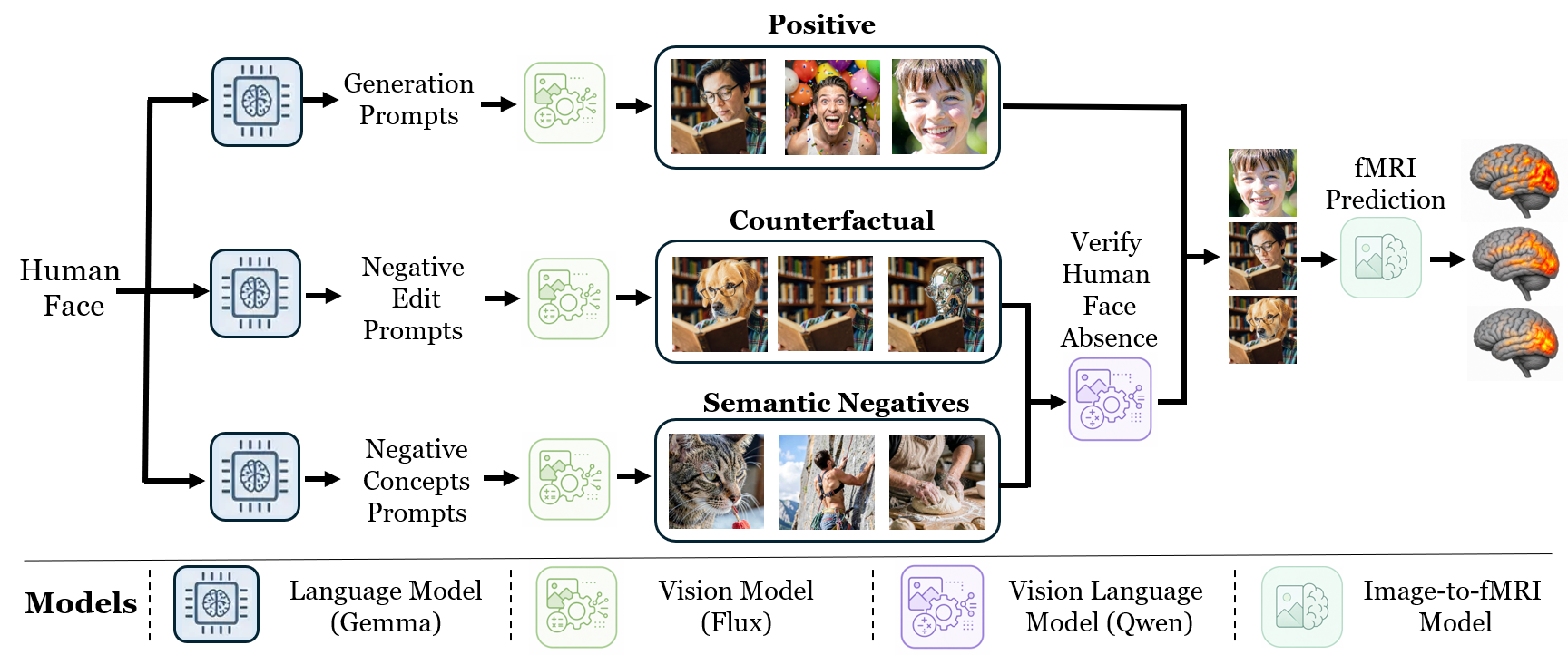
BrainCause Builds Controlled Visual Evidence
Given a target concept, BrainCause constructs a causal dataset designed to isolate the concept from correlated visual and semantic factors. The dataset includes positive images, semantic negatives, and counterfactual negatives in which the target concept is removed or replaced while preserving the rest of the image.
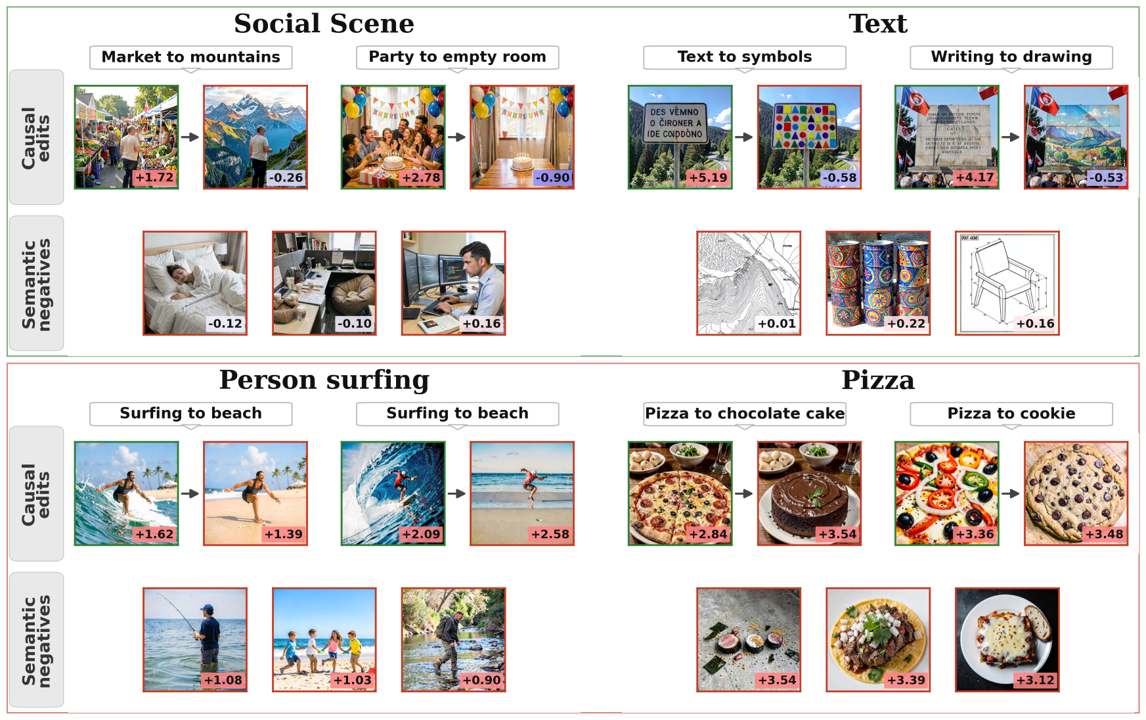
Causal Testing Examples
The top row shows regions discovered by BrainCause: they respond strongly to positive images, but drop for counterfactual edits and semantic negatives. The bottom row shows regions found by activation alone, which often remain highly active after edits or for related negatives, indicating false positives driven by correlated cues.
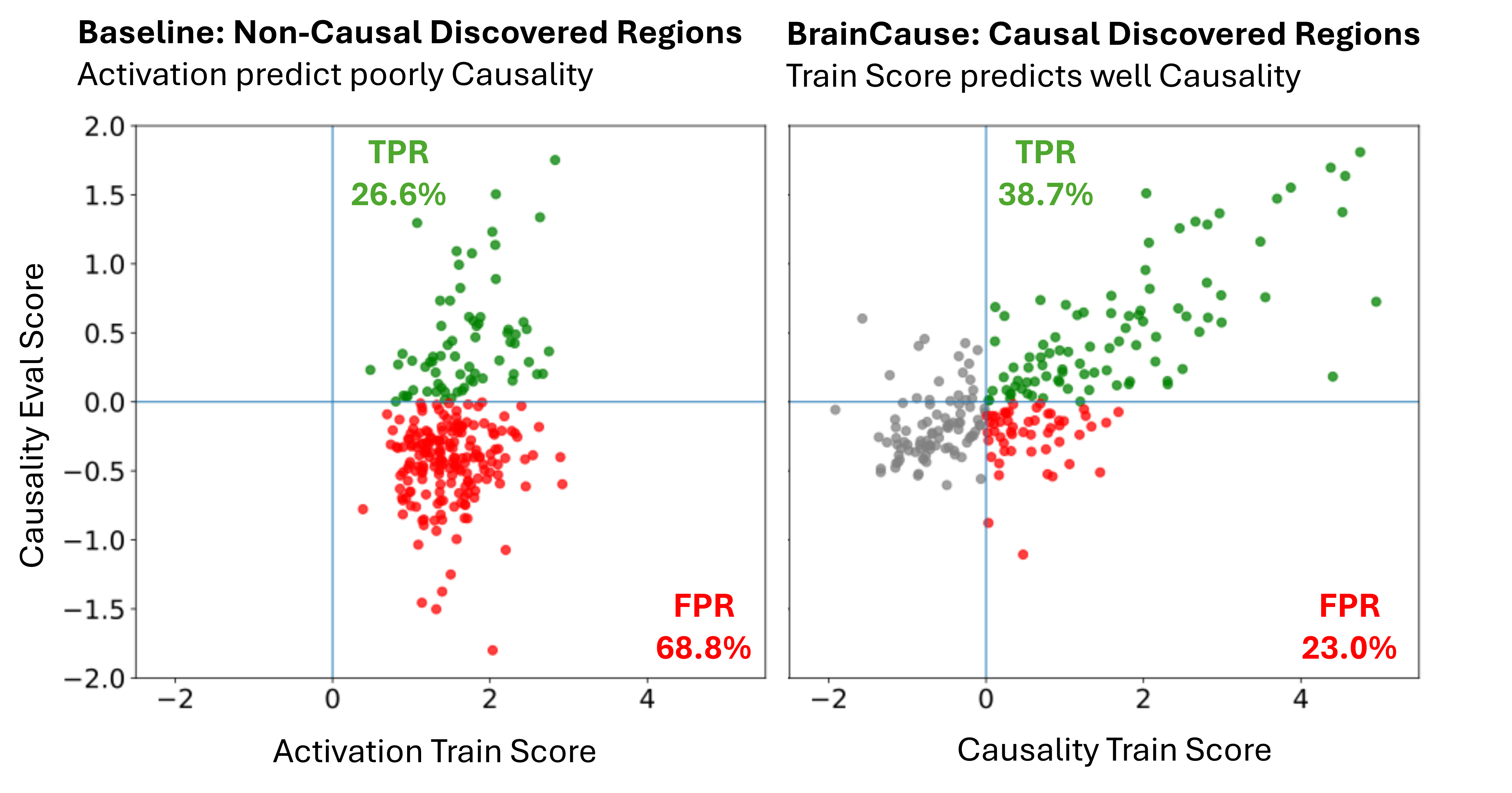
Causal Ranking Reduces False Discoveries
Each point represents one concept: the x-axis shows the score used for discovery on the training set, and the y-axis shows causal validation on the held-out evaluation set. Activation-based discovery frequently selects regions that respond strongly to the target concept but are not causally specific, leading to many false positives. By ranking candidates using causal score, BrainCause suppresses correlation-driven discoveries and recovers more faithful concept representations.
Concepts Discovered by Causal Evaluation
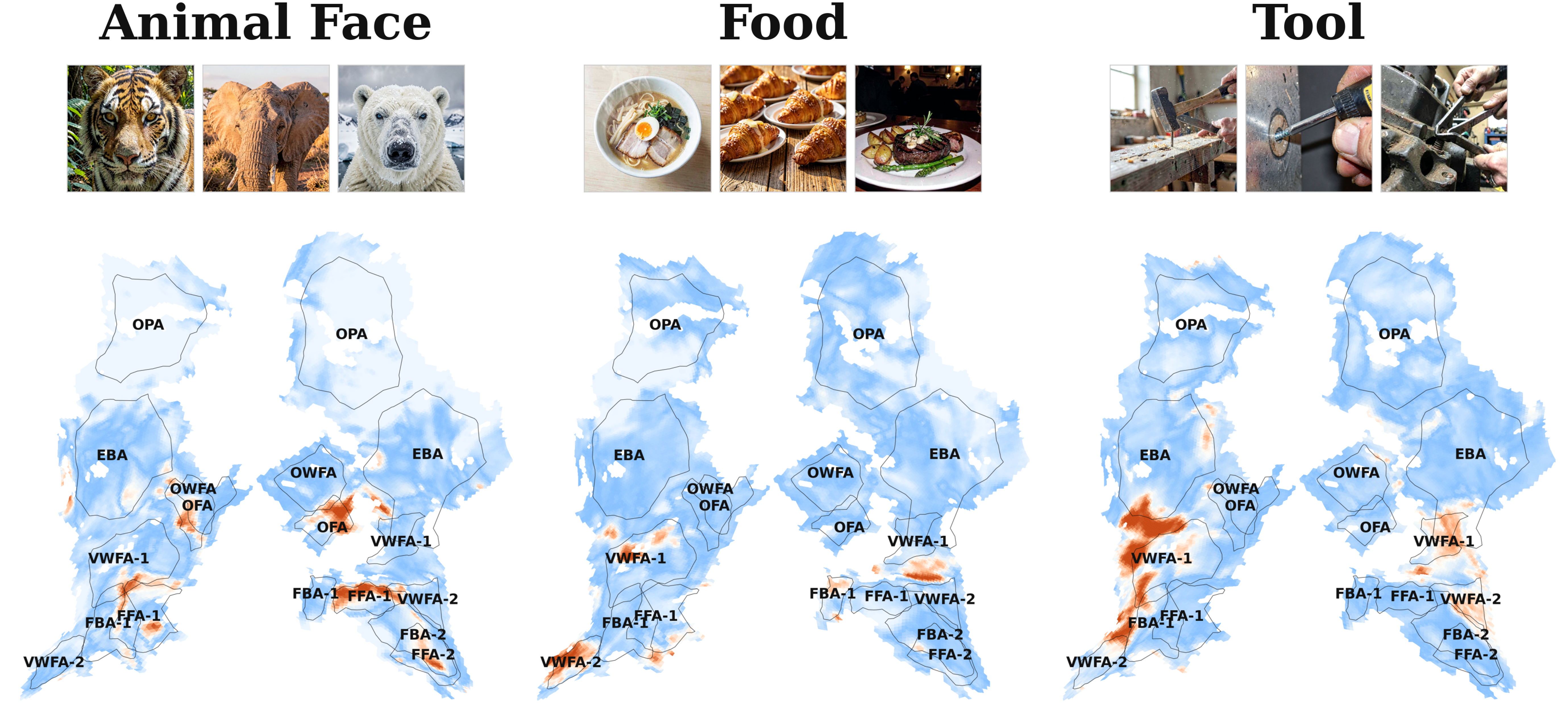
We show voxel-wise causal scores on brain maps for three example concepts, with representative positive images above each map. Each panel shows a flatmap of high-level visual cortex. Each voxel is colored by its causal score, where warmer colors indicate higher concept-specific causal evidence. Black outlines and labels mark NSD functional ROIs, allowing comparison with known visual regions.
Fine-Grained Organization of Related Concepts
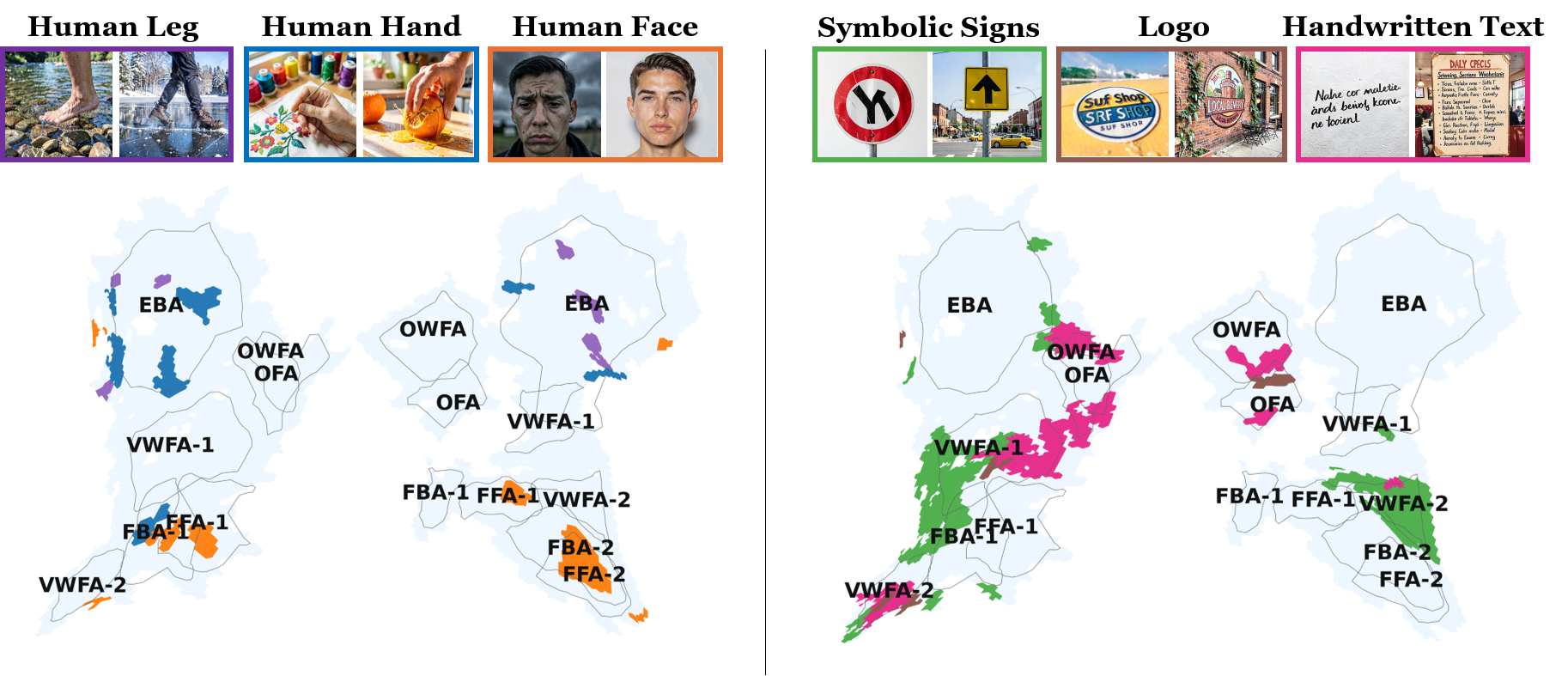
On the left, body-related concepts such as human face, human hand, and human leg show distinct voxel patterns across face- and body-selective regions. On the right, text-related concepts such as handwritten text, symbolic signs, and logos show distinct voxel patterns across word- and object-related visual areas. These results show that BrainCause discovers nearby semantic categories within high-level visual cortex.
Cross-Subject Consistency
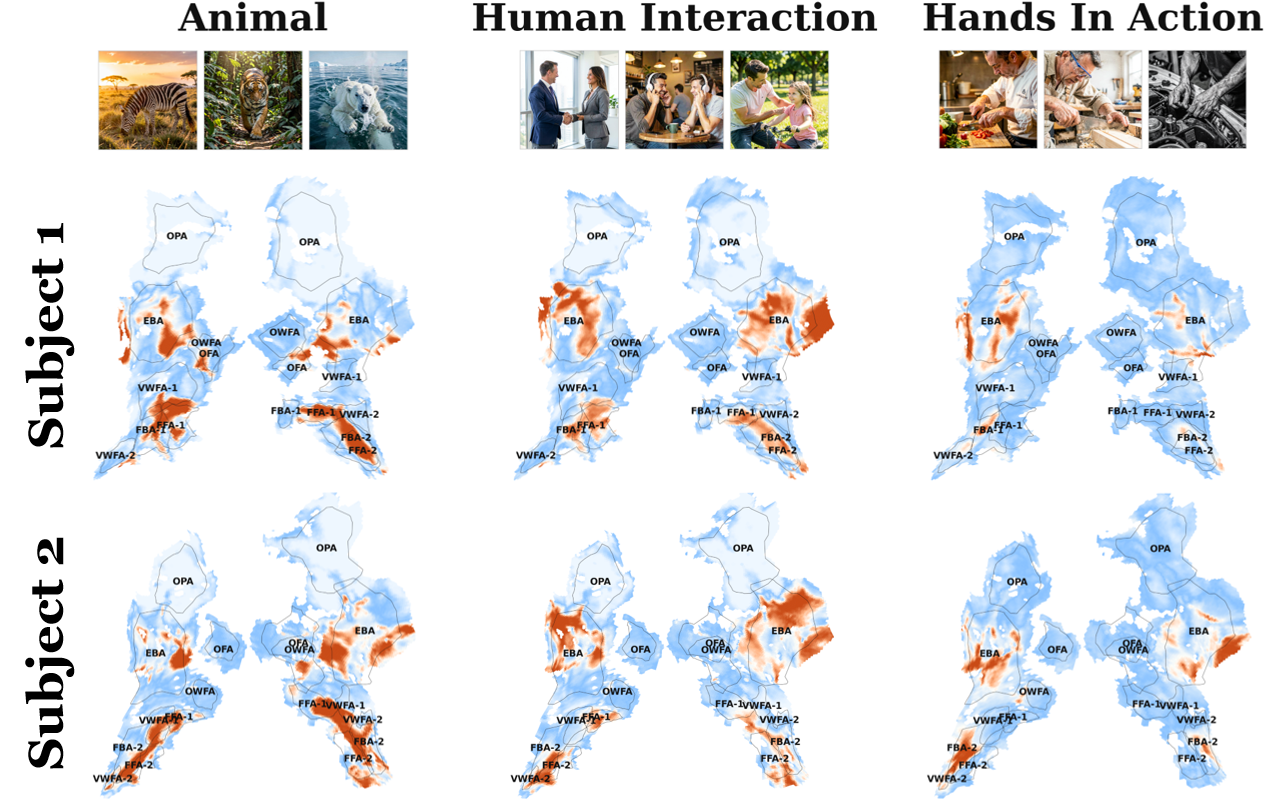
We compare BrainCause causal maps for the same concepts across NSD subjects. Columns show concepts, rows show subjects, and warmer colors indicate stronger causal evidence. Across subjects, high-scoring voxels appear in similar highlevel visual regions, demonstrating that BrainCause discovers spatially localized and reproducible representations despite individual variability in cortical organization.
Causal Versus Activation-Based Localization
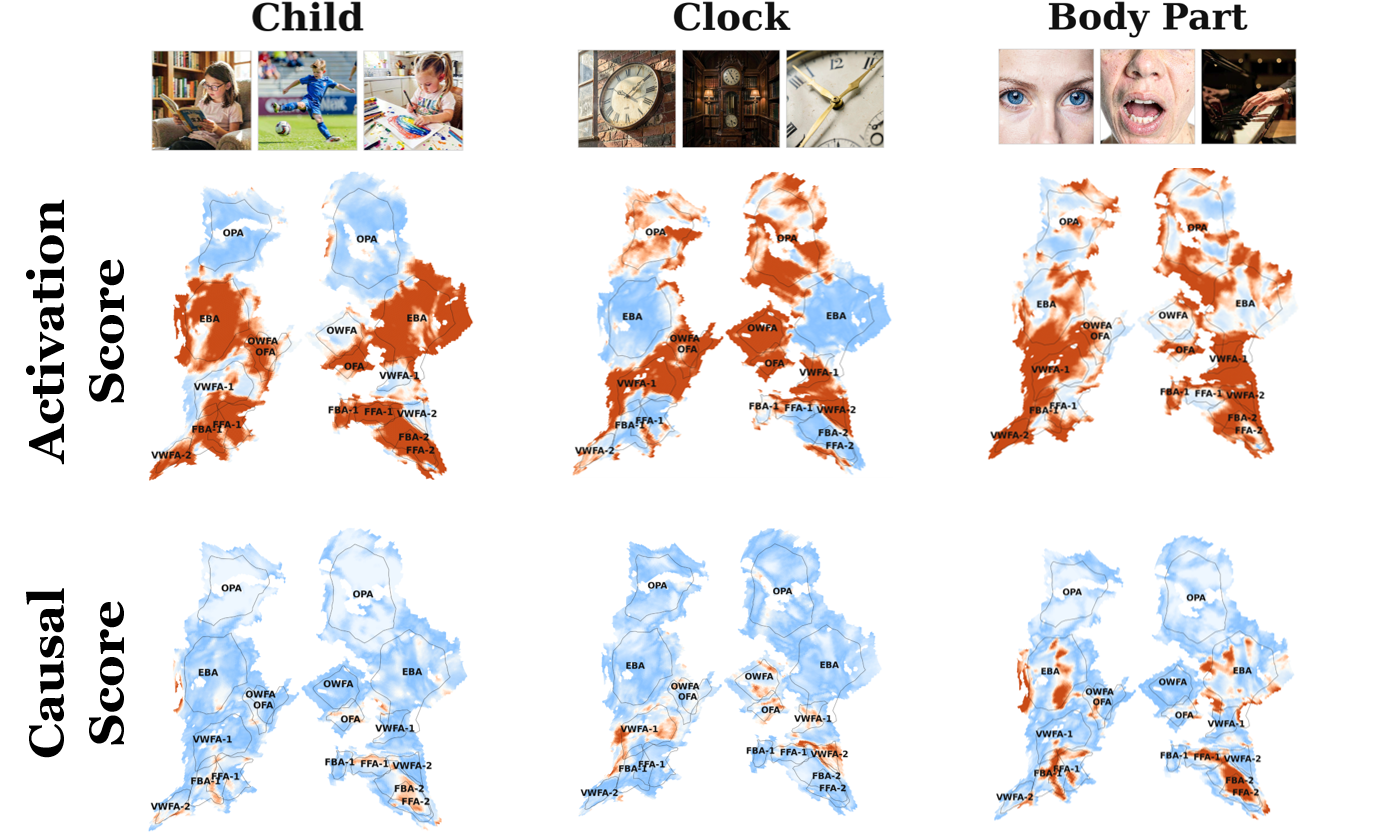
Maps compare BrainCause causal scoring with activation-based localization for Child, Clock, and Body Part. Across these examples, activation-based localization produces broad high-response patterns, while causal scoring yields more selective maps by suppressing responses driven by correlated visual or semantic cues.
BibTeX
@article{golbari2026braincause,
  title   = {From Activation to Causality: Discovery of Causal Visual Representations in the Human Brain},
  author  = {Golbari, Yuval and Wasserman, Navve and Cosarinsky, Matias and Beliy, Roman and Oliva, Aude and Torralba, Antonio and Irani, Michal and Rott Shaham, Tamar},
  journal = {arXiv preprint arXiv:2605.23895},
  year    = {2026},
  url     = {https://arxiv.org/abs/2605.23895},
  doi     = {10.48550/arXiv.2605.23895}
}